
Choosing between Direct View LED and LCD is an important decision for businesses investing in commercial digital displays. Both technologies can deliver high-quality images, but their brightness, resolution, installation flexibility, and operating requirements differ significantly.
Direct View LED (DVLED) is a display technology in which individual light-emitting diodes produce the visible image directly, without an LCD panel or separate backlight. Its modular design makes it suitable for applications ranging from retail advertising and digital signage to corporate video walls.
However, choosing a high-quality direct view LED display involves more than finding the brightest screen or the smallest pixel pitch.
This guide explains how DVLED works, compares it with LCD, and explores the technical considerations that help commercial buyers, distributors, and system integrators select the right display.
What Is Direct View LED (DVLED)?
Direct View LED is a self-emissive display technology that uses arrays of light-emitting diodes to create images. Unlike conventional LCD screens, which require a backlight, the light-producing elements in a DVLED display form the image itself.
Because these elements can be assembled into modules and cabinets, manufacturers can create displays in different sizes and configurations without relying on a single fixed-size glass panel.
How Does Direct View LED Technology Work?
A direct view LED display consists of LED pixels, modules, display cabinets, control electronics, and a content source.
Each full-color pixel contains red, green, and blue light-producing elements. By adjusting their relative output, the display produces different colors and brightness levels.
The pixels are arranged across LED modules, which are assembled into a complete display surface. A receiving and processing system distributes image data to the appropriate modules.
This modular construction allows multiple sections to form a larger image while minimizing visible borders between them.
However, image quality depends on more than the LEDs themselves. Pixel spacing, signal processing, module calibration, power management, and mechanical alignment all influence the final result.
Direct View LED vs LED-Backlit LCD: What’s the Difference?
The term “LED display” can be confusing because many LCD televisions and commercial monitors are advertised as LED screens.
An LED-backlit LCD uses LEDs as its light source, but the image is formed by a liquid crystal layer that controls how light passes through the panel.
Direct View LED works differently. Its LEDs produce the image directly.
This distinction affects contrast, brightness, display construction, and the way screen dimensions can be configured.
Direct View LED vs LCD: Key Differences for Commercial Displays
Neither DVLED nor LCD is automatically the better choice for every commercial project. Their suitability depends on where the display will operate, what it needs to show, and how people will view it.
| Comparison Factor | Direct View LED | LCD |
| Display technology | Self-emissive LED pixels | Liquid crystal panel with backlight |
| Brightness | High-output configurations available | Standard and high-brightness commercial models |
| Image detail | Depends on pixel pitch and dimensions | High pixel density common in standard sizes |
| Screen configuration | Modular and customizable | Primarily fixed panel dimensions |
| Multi-panel appearance | Can form a near-seamless surface | Panel bezels may remain visible |
| Power consumption | Depends on content, brightness and design | Depends on backlight, brightness and panel design |
| Maintenance | Module-level servicing possible, depending on product | Panel or component servicing, depending on model |
| Initial investment | Often higher for fine-pitch configurations | Often lower for comparable standard-sized installations |
Brightness and Visibility in High Ambient Light
Brightness is particularly important for displays positioned near windows, under strong retail lighting, or in spaces exposed to daylight.
It is generally measured in nits, equivalent to candela per square meter (cd/m²).
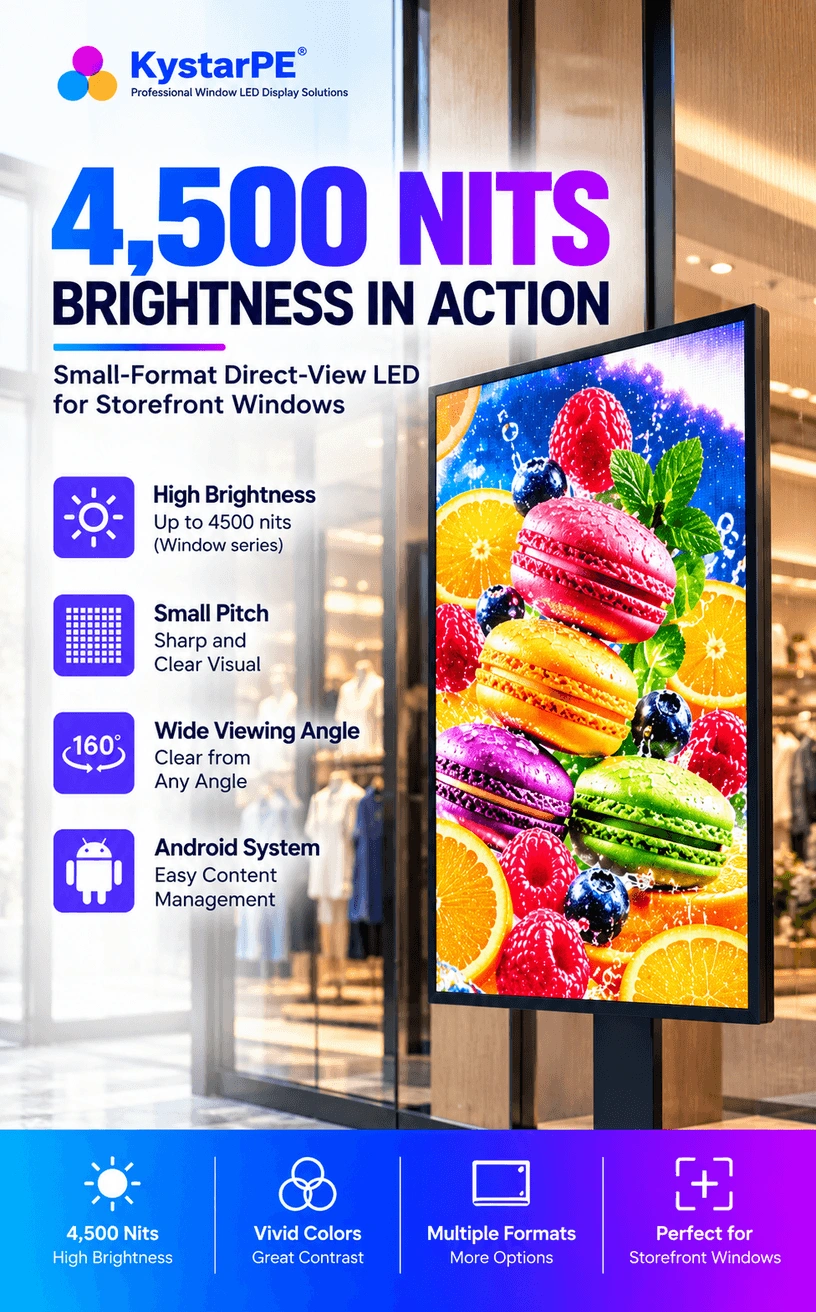
Direct View LED products can be configured for high-brightness applications, making them useful where conventional indoor screens may appear difficult to read.
However, high-brightness LCD products are also available.
When comparing the two, buyers should examine actual rated brightness, screen reflections, contrast, viewing direction, and ambient lighting conditions.
Maximum brightness alone cannot predict real-world visibility.
Image Quality, Contrast and Viewing Distance
Image quality depends on resolution, contrast, color performance, and the distance between the display and its audience.
Direct View LED offers pixel-level light control, supporting strong contrast and vivid visual content. Its appearance can be especially effective for large graphics, video, and promotional messaging.
LCD displays typically offer higher pixel density in compact screen sizes, making them suitable for detailed text, spreadsheets, and applications viewed at close range.
A screen positioned several meters from passing customers has different requirements from a monitor used by someone standing directly in front of it.
The best commercial display is not necessarily the one with the highest specification. It is the one whose specifications match the viewing environment and content requirements.
Screen Size, Bezels and Installation Flexibility
LCD panels are manufactured in standard dimensions. Creating a larger LCD video wall usually requires combining several panels, which may leave visible boundaries between screens.
Direct View LED uses modular components that can create larger surfaces without the same panel-bezel structure.
The technology also supports various aspect ratios and customized dimensions.
For example, a retail business may require a narrow advertising display above a product shelf rather than a conventional widescreen monitor.
Modular LED technology can accommodate these requirements, although cabinet dimensions, installation tolerances, and available modules still determine the final design.
Power Consumption, Lifespan and Maintenance
Energy consumption is an important consideration for commercial displays operating throughout the day.
Neither technology is universally more energy-efficient.
A DVLED display’s power consumption depends on its brightness setting, displayed content, pixel technology, electronics, and operating conditions. LCD power requirements depend on factors including screen size, backlight operation, and panel design.
Buyers should request both typical and maximum power consumption figures under clearly defined conditions.
Product lifespan also requires careful interpretation. Manufacturer lifespan ratings may describe a specified reduction in brightness rather than the point at which a display stops functioning.
Some DVLED products support front-access module replacement, while others require rear access.
Before installation, verify the selected product’s service access and replacement procedures.
Initial Cost vs Total Cost of Ownership
LCD is often the more economical option for a conventional, single-screen installation.
Fine-pitch DVLED may involve higher initial equipment costs, particularly when the application requires close viewing distances and high image detail.
Total cost of ownership should include installation, supporting structures, electricity, content control equipment, maintenance, replacement parts, and potential downtime.
For multi-location deployments, buyers should also consider how easily displays can be managed and maintained consistently.
A realistic comparison uses project-specific quotations and operating assumptions rather than general claims about long-term savings.
What Makes a High-Quality Direct View LED Display?
A high-quality direct view LED display should deliver consistent image performance under its intended operating conditions.
Evaluating quality requires examining several related specifications rather than relying on a single headline feature.
Pixel Pitch, Resolution and Viewing Distance
Pixel pitch describes the center-to-center distance between neighboring LED pixels, measured in millimeters.
A smaller pixel pitch places pixels closer together, increasing the potential pixel density within a given display area.
Fine-pitch configurations are particularly relevant to indoor applications where viewers stand relatively close to the screen.
However, smaller pixel pitch is not always necessary.
For displays viewed from longer distances, a larger pitch may provide sufficient image quality at a more appropriate cost.
Buyers should evaluate pixel pitch alongside physical screen dimensions, total resolution, content detail, and expected viewing distance.
A practical assessment should include viewing the intended content on a sample display from the expected audience positions.
Brightness, Contrast and Color Uniformity
A high-quality DVLED display should provide suitable brightness without sacrificing image consistency.
Excessive brightness can be uncomfortable in darker indoor environments, while insufficient brightness can reduce visibility near windows.
Contrast affects how clearly dark and bright image areas are separated.
Color uniformity is equally important, especially when a display contains multiple modules.
Differences in color or brightness between modules may become noticeable when displaying a single-color background or large corporate graphics.
Buyers should therefore ask about factory calibration, module matching, and the procedures used to maintain consistent image output.
Refresh Rate, Calibration and Display Reliability
Refresh rate describes how frequently a display updates its image output. In LED display specifications, it should be distinguished from the incoming video frame rate.
A suitable refresh rate can help reduce unwanted visual artifacts, particularly when displays are recorded by cameras.
Calibration helps align brightness and color across the display surface.
Reliability should be evaluated through documented testing procedures, component quality, thermal management, and maintenance design.
For commercial procurement, buyers should also request information about pixel defect policies, operating temperature, and replacement module availability.
These details provide a more useful picture of product quality than broad marketing descriptions.
COB vs GOB vs SMD LED Packaging
LED packaging affects pixel construction, physical protection, manufacturing requirements, and service considerations.
SMD (Surface-Mounted Device) technology uses packaged LED components mounted onto a circuit board. It is established across many indoor and outdoor display applications.
COB (Chip on Board) mounts LED chips directly onto a substrate and uses an encapsulation structure. It can support compact pixel arrangements and provide additional surface protection, depending on its design.
GOB (Glue on Board) generally applies a protective encapsulation layer over an LED module, often using an SMD-based construction.
COB and GOB are therefore not simply interchangeable technologies.
The appropriate option depends on pixel pitch, installation environment, handling requirements, optical performance, and repair approach.
For high-contact environments or fine-pitch indoor displays, protective construction can be an important consideration. Nevertheless, buyers should verify actual product specifications instead of assuming that one packaging method always outperforms another.
Where Is Direct View LED Used in Commercial Environments?
Direct View LED serves many commercial applications, but different environments call for different configurations.
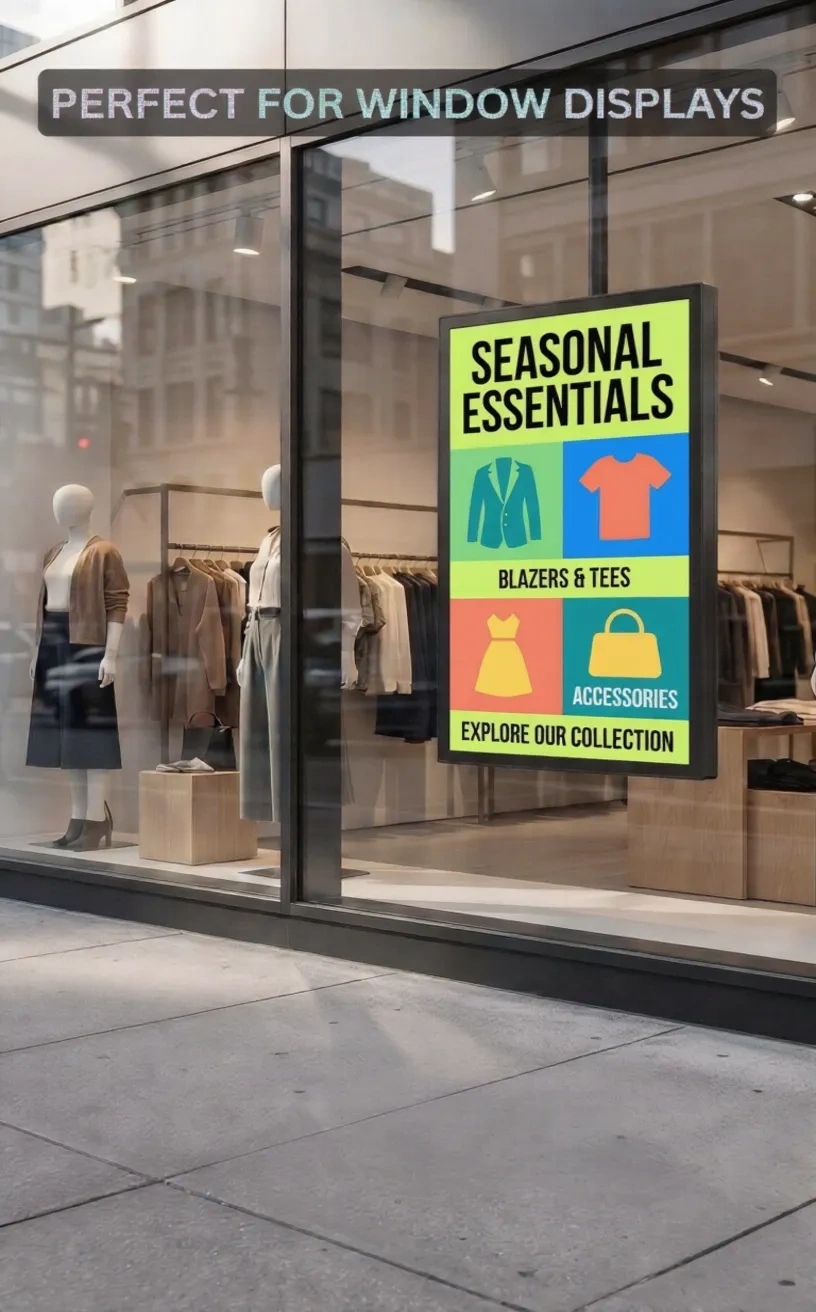
Retail Stores and Shop Window Advertising
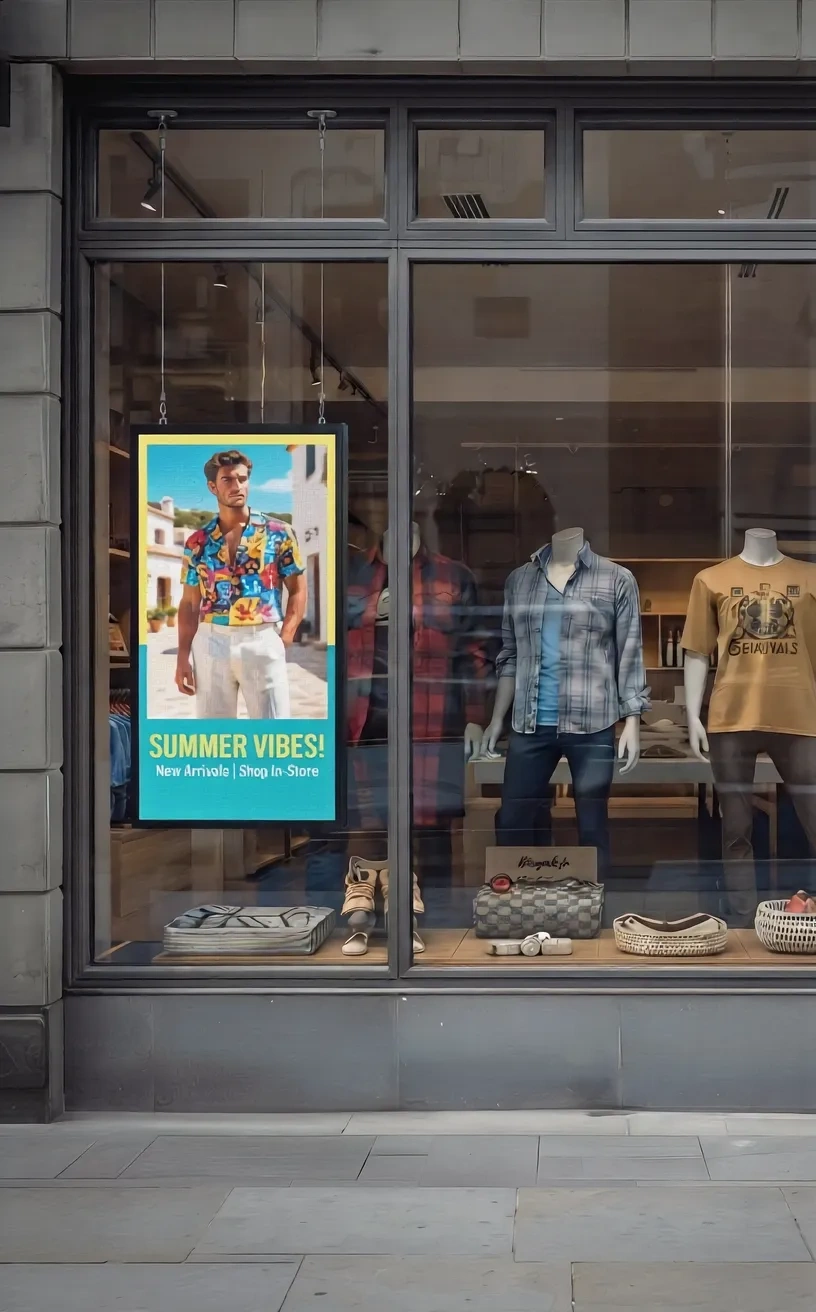
Retail window displays must remain visible while competing with daylight, reflections, and surrounding advertising.
High-brightness DVLED can support dynamic campaigns, product launches, and promotional videos in these environments.
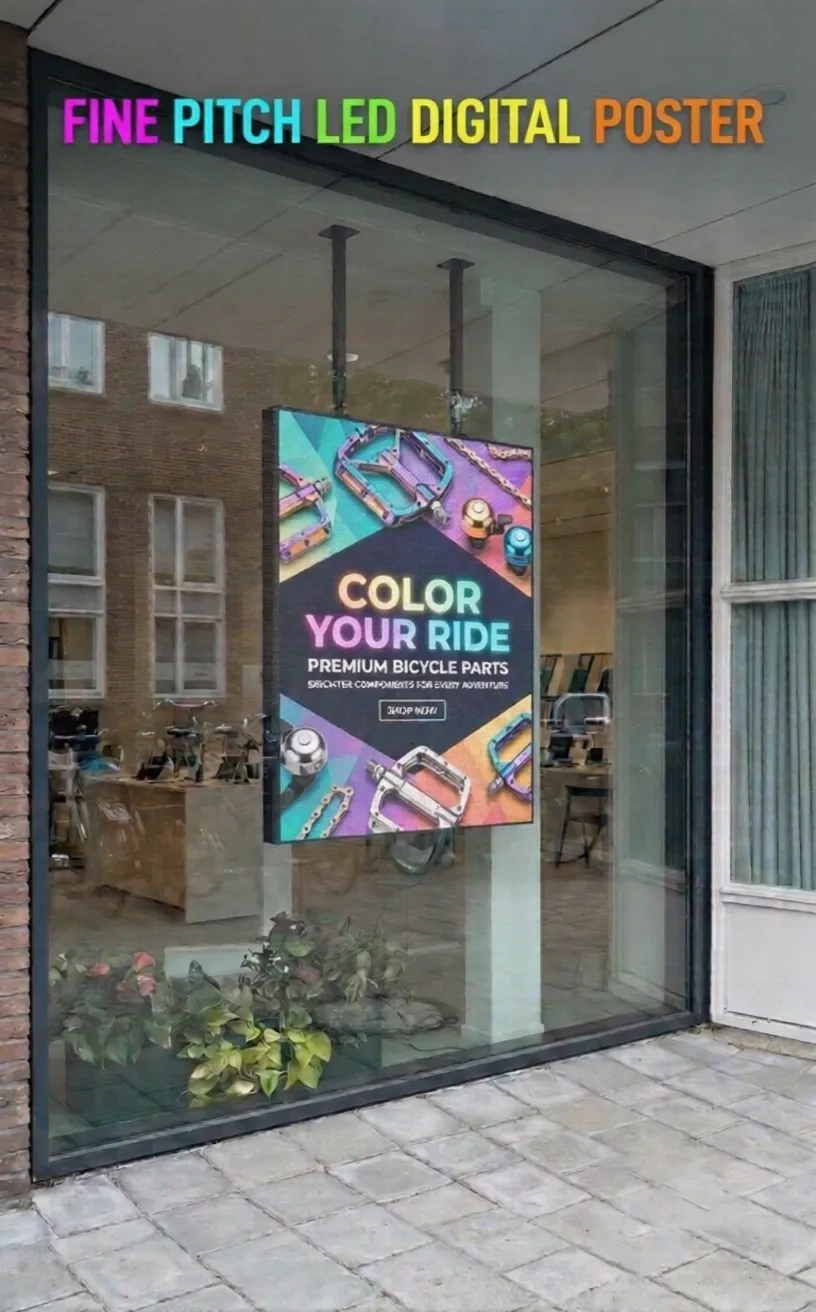
Fine-pitch technology is particularly relevant where pedestrians view the screen from relatively short distances.
Vertical LED posters and standard-sized commercial displays may also suit existing advertising spaces.
For window applications, buyers should check the direction of incoming sunlight, viewing angles, installation depth, and ventilation before selecting a screen.
Corporate Offices, Meeting Rooms and Video Walls
Corporate environments commonly use large displays for presentations, brand communication, and collaborative meetings.
Direct View LED can create large display surfaces with minimal visual interruption between modules.
For smaller meeting rooms, however, detailed text and close viewing may favor an LCD panel with higher pixel density.
When evaluating DVLED for a corporate installation, consider seating distances, presentation content, camera recording requirements, and integration with the existing audiovisual system.
Restaurants, Hospitality and Digital Signage
Restaurants and hospitality businesses need displays for menus, promotional campaigns, guest information, and branding.
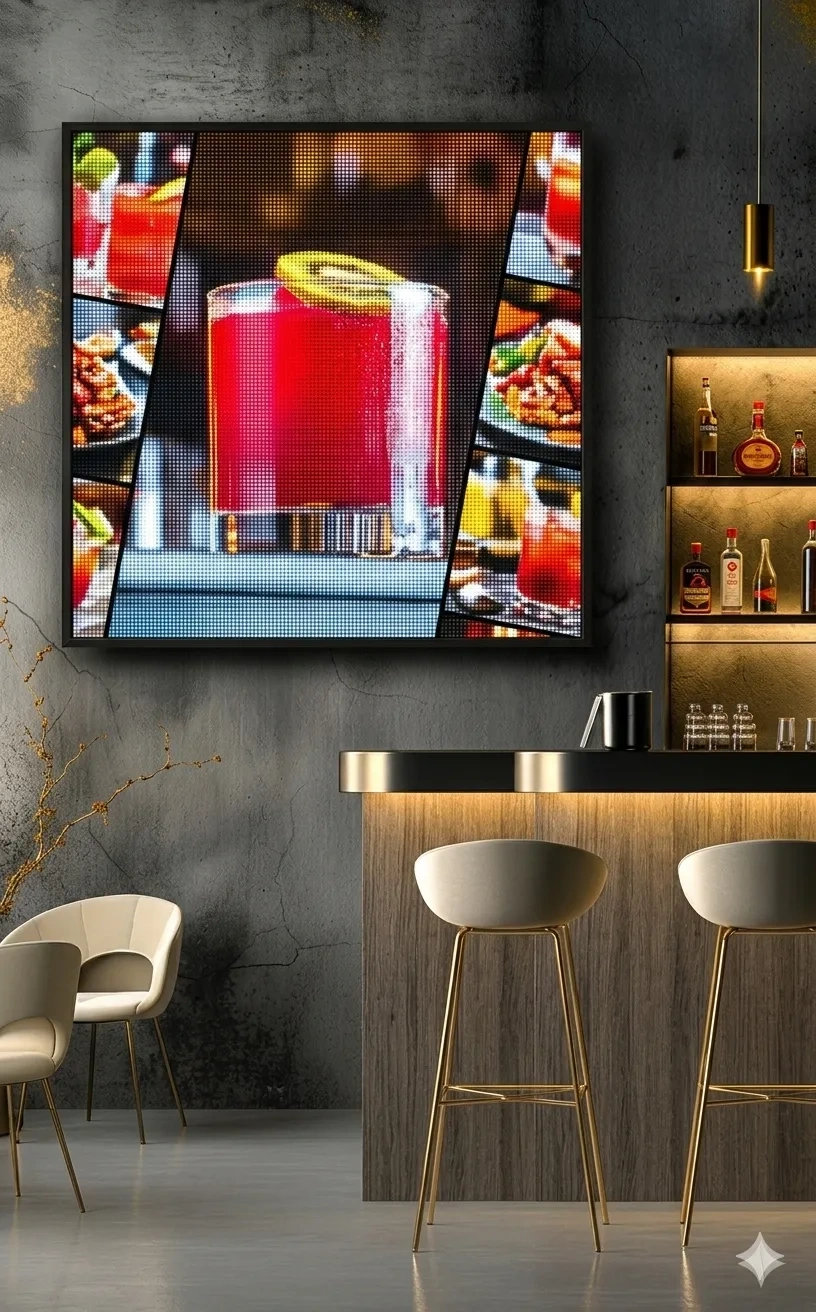
DVLED can be useful in brightly lit dining areas, hotel lobbies, and promotional spaces requiring strong visual impact.
Standard-sized screens work well for many applications, while elongated LED displays may fit narrow architectural spaces.
For menu boards containing small text and detailed prices, resolution and comfortable viewing distance deserve particular attention.
Other Commercial and Public Spaces
Schools, churches, transportation facilities, healthcare environments, and public venues also use Direct View LED.
Typical applications include event displays, information boards, wayfinding, and large-format presentations.
Each setting introduces different operating requirements.
A transportation display may prioritize legibility and operating reliability, while an auditorium may place greater emphasis on image scale and viewing angles.
When Should You Choose DVLED Instead of LCD?
Understanding the technology is useful, but procurement decisions ultimately depend on the application.
When Direct View LED Is the Better Fit
DVLED deserves consideration when a project requires a large display surface, flexible screen dimensions, minimal visible seams, or strong visibility under challenging lighting conditions.
It is also suitable for projects in which visual content is primarily viewed from a moderate or long distance.
Retail advertising, branded environments, and customized digital signage are examples where these characteristics can be valuable.
The final choice should still reflect budget, image resolution, available space, and operating requirements.
When LCD May Be the More Practical Choice
LCD often remains practical for applications that require high-resolution text, detailed graphics, and close viewing.
Standard-sized LCD monitors may also offer lower acquisition costs and straightforward integration with existing equipment.
A checkout information screen, office monitor, or small meeting room display may not benefit sufficiently from modular LED construction to justify the additional investment.
Selecting LCD in these situations is not a compromise in quality. It reflects a different set of operating priorities.
Can Fine-Pitch DVLED Replace Standard LCD Digital Signage?
Fine-pitch DVLED can replace LCD signage in selected commercial applications, particularly where brightness, visual presentation, and modular construction provide meaningful advantages.
KYStarpe focuses on small-pitch direct-view LED solutions, including commercial digital signage, vertical LED posters, and stretched LED displays.
Some configurations use dimensions comparable to common LCD installations, potentially simplifying display planning.
However, replacing an LCD requires more than matching its nominal diagonal size.
Buyers must evaluate actual dimensions, resolution, pixel pitch, mounting arrangements, power requirements, ventilation, and content compatibility.
A technically suitable replacement should provide the required viewing experience within the installation’s physical and operational constraints.
How to Choose the Right Direct View LED Display for Your Project
Commercial buyers can reduce specification mismatches by establishing their application requirements before requesting quotations.
Define Your Viewing Distance, Display Size and Content Requirements
Start with the audience.
Determine how far viewers will stand from the display, whether they will be moving, and whether the content consists primarily of text, images, or video.
Next, confirm the available installation dimensions and desired screen orientation.
A retail poster, restaurant menu board, and meeting room presentation screen may require different resolutions even when their physical dimensions are similar.
Ambient lighting should also be documented, particularly for displays facing windows.
These details help manufacturers recommend an appropriate pixel pitch and brightness range.
Compare Technical Specifications and Installation Requirements
Compare proposed products using consistent criteria.
These should include pixel pitch, resolution, rated brightness, viewing angle, power consumption, operating environment, cabinet dimensions, and maintenance access.
The control system and signal input requirements also deserve attention.
For multi-screen installations, confirm content synchronization, remote management capabilities, and compatibility with existing digital signage software.
Installation planning should address load-bearing arrangements, electrical connections, cooling, and access for servicing.
What Should You Ask a Direct View LED Manufacturer?
Before placing a wholesale or project order, request a model-specific technical datasheet and clarify how important performance figures are measured.
Ask whether brightness and color-uniformity testing are available, how pixel defects are handled, and whether replacement modules can be supplied.
Confirm warranty coverage, operating conditions, and the available maintenance approach.
For distributors and system integrators, sample evaluation can provide valuable evidence before committing to a wider installation.
At KYStarpe, we offer commercial Direct View LED solutions covering fine-pitch displays, standard-sized signage, vertical posters, and customized formats.
Prospective partners can discuss their project specifications and enquire about sample availability to assess display performance before a larger purchase.
Frequently Asked Questions About Direct View LED
Is Direct View LED the Same as an LED TV?
Not necessarily. Many products described as LED TVs use LCD panels with LED backlights. Direct View LED creates images directly through its LED pixels without a separate LCD layer.
Is Direct View LED Better Than LCD?
Neither technology is universally better. DVLED can be advantageous for modular displays, large surfaces, and certain high-brightness applications. LCD often performs well where compact dimensions, detailed text, high pixel density, and lower initial cost are priorities.
What Is the Best Pixel Pitch for Indoor Direct View LED?
The best pixel pitch depends on viewing distance, display size, content detail, and budget. Smaller pitch supports greater pixel density but may increase cost. Buyers should compare actual screen resolution and evaluate a sample from their expected viewing distance.
Can Direct View LED Be Used in Small Commercial Displays?
Yes. Fine-pitch LED technology enables compact commercial displays, including vertical posters, retail signage, and standard-sized digital advertising screens. Product dimensions and image resolution should be checked against the intended application.
How Long Does a Direct View LED Display Last?
Lifespan varies by product design, operating conditions, and the manufacturer’s measurement criteria. Some LED products are marketed with long rated operating lives, but these figures should not be interpreted as guaranteed years of uninterrupted operation. Buyers should confirm the relevant brightness-degradation definition, test conditions, and warranty terms.
Choosing a Display That Fits Your Commercial Project
Direct View LED and LCD each offer valuable capabilities for commercial display projects.
DVLED provides flexibility in screen construction, strong visual impact, and high-brightness options. LCD continues to offer practical advantages for compact installations requiring detailed resolution and controlled initial costs.
The most reliable buying decision starts with an accurate understanding of the installation environment, viewing requirements, content, and total ownership costs.
If you are evaluating Direct View LED for retail advertising, commercial signage, or a customized display installation, KYStarpe can help you review the technical requirements and explore suitable fine-pitch LED configurations.
Explore our Direct View LED Digital Signage Solutions to review available options and discuss your project requirements with KYStarpe.